The End of an Empire
The Fall of Constantinople stands as one of the most significant transformation points in human history, marking the definitive collapse of the Eastern Roman Empire, also known as the Byzantine Empire. For over a millennium, Constantinople stood as the shining jewel of Christendom, an economic powerhouse that held trade influence around the entire world. It was the foremost gateway between Europe and Asia, filtering the vast wealth of the Silk Road. However, by the mid-15th century, the empire was but a shadow of its former self, little more than a fractured city-state. It was also surrounded by the heavily energetic and threatening Ottoman Empire.
On the 29th of May, 1453, the culmination of the city’s siege was not merely a local invasion, but a clash of civilisations that altered the trade, culture and political layout of the entire Western world. This single day dissolved a political leadership that could trace its lineage back to Augustus Caesar.
The geopolitics leading up to the assault revealed a stark contrast between the two sides. One was a fading dynasty desperately trying to survive, while the other was an ascendant superpower. The Byzantine Empire had been plagued by centuries of financial decay, civil wars and a devastating sack of the city in 1204 by Western Crusaders during the Fourth Crusade. The capital was heavily depopulated by 1450, with only a few scattered territories in Greece. In contrast, however, the Ottoman Empire was thriving. The young Sultan Mehmed II had taken the throne in 1451 with a singular objective in mind – to capture Constantinople and consolidate his name in time as a conqueror. He knew that whoever had control of this city held dominion over the Eastern Mediterranean. To isolate the city, the sultan first ordered the construction of the Rumeli Hisari fortress along the Bosporus Strait, effectively cutting off the city’s path to the Black Sea region, and blocking the income of vital grain and allies.
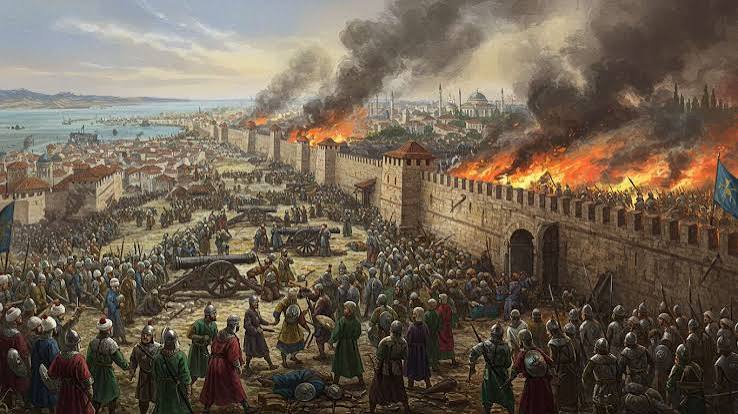
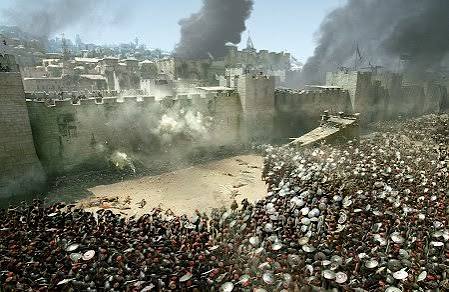
In early April 1453, the siege began. The emperor of the Byzantine Empire was Constantine XI Palaiologos, who governed a city that held a richness in culture but was severely depleted in manpower. As such, he could only muster around 7000 to 8000 men to fight, many of whom were foreign mercenaries and volunteers . Facing them was Mehmed’s highly trained army of 70,000 to 80,000 combatants, ten times as many as the defenders had, including the elite Janissary corps that were fanatically loyal to their sultan. Usually for a medieval siege, the commander often relied on starvation tactics. In this particular scenario, that would’ve been a viable option. However, the Ottoman strategy utilised massive, bronze Basilic cannons, designed by a Hungarian engineer named Orban, that systematically battered the ancient stone ramparts. The weapons required dozens of oxen to pull and needed several hours to cool down in between shots. This was the dawn of early-age artillery, and the end of traditional fortifications as they had known it. The psychological pressure on the soldiers was immense; the relentless cannon fire broke any sense of invulnerability they had and rapidly drained away hope.
Midway through the siege, a naval stalemate came into play. The Byzantines had blocked the entrance to their Golden Horn harbour using a large iron chain that was stretched across the length of the harbour. In a remarkable display of engineering, Mehmed ordered the construction of a wooden road of greased logs over land. Under the cover of night, Ottoman soldiers dragged dozens of warships and slid them directly into the harbour, bypassing the chain entirely.
The final breakthrough was on the 29th of May, when the city at last fell to its attackers. This marked the sure end of Roman authority in the East, ushering in a dramatic new order. In the final battles, the Ottoman forces bypassed the broken defensive lines and engaged in hand-to-hand combat, with the emperor last seen throwing off his imperial regalia to die fighting with his soldiers. Mehmed II entered the city later that day, immediately claiming the grand Hagia Sophia cathedral – the largest and most sacred dome in the Christian world – and converting it into the imperial mosque. Famously, he stopped a soldier from damaging the marble floors, declaring them to be the property of the Crown. The city was renamed Istanbul, becoming the capital of the Ottoman Empire. Mehmed, who did not wish to rule over ruins, set out to rebuild it, inviting Greek, Armenian and Jewish communities to repopulate the city.
This event sent shockwaves of panic across the kingdoms of Western Christendom, which suddenly found a powerful Islamic empire positioned right at their doorstep. Popes called for crusades that were never formed, as European monarchs were far too involved in their own conflicts to be able to unite against the new threat.
There were also several long-term effects, changing trade, exploration and the political balance of power for centuries to come. European merchants who had previously passed into the Asian lands easily now found that their journeys were heavily taxed or entirely blocked. This forced European kingdoms to look west and south towards the oceans, eventually leading to the Age of Discovery and inspiring the legendary maritime adventurers like Christopher Columbus and Vasco de Gama, who sought to bypass the Ottoman territories in their entirety. Additionally, the groups of Greek scholars and the wealth of classical texts fleeing the fallen city to Italy sparked a large intellectual revival, acting as a notable catalyst for European Renaissance and the birth of modern scientific thought.


Leave a Reply