
The White Death
When one thinks of history’s deadliest warriors, they usually imagine knights in armour, screaming Vikings, or battle-hardened Roman generals. Rarely does one imagine a quiet Finnish farmer, barely five-foot-three, lying motionless beneath the snow with an old bolt-action rifle. However, during one particularly brutal winter, such an unassuming man became so feared that an entire invading army gave him a name that is still recalled through military history: The White Death.
Simo Häyhä was born in rural Finland in the year 1905. At that time, life mainly revolved around cold winters, dense forests, and a lot of gritty hard work. Häyhä grew up on a farm, hunting animals to feed his family, and in those years he spent countless hours perfecting his skills in Finland’s rugged wilderness. By the time he reached adulthood, he was already known as an outstanding shooter. None, however, could have imagined that this seemingly ordinary man would go on to become one of the most feared snipers in history.
The war began in November 1939, when the Soviet Union invaded Finland and began what would eventually become known as the Winter War. On paper, it should have been a quick victory. The Soviets possessed hundreds of thousands of troops, thousands of tanks, and overwhelming firepower. Finland, by comparison, was desperately outnumbered. However, the invaders had ignored a crucial aspect in this conflict. The terrain.
While the Soviet soldiers struggled to move through waist-deep snow and unforgiving temperatures, the Finnish soldiers practically thrived in the environment they were used to. Häyhä was even a notch ahead, as he, with his white camouflage coat, effectively blended into the surrounding snowy forests. Unlike the majority of snipers, Häyhä had refused to make use of a telescopic sight. The reasoning behind this was that a scope could reflect sunlight and hence reveal his position to enemy lookouts, while iron sights allowed him to keep his head lower behind the rifle. It is known that Häyhä packed snow in front of his firing position in order to prevent the blast from having powder thrown into the air. He even placed snow into his mouth to stop his breath from freezing the surrounding air. Every tiny detail increased his chances of surviving another day, and made him even more deadly to his enemies.
From then, the bodies began piling up.
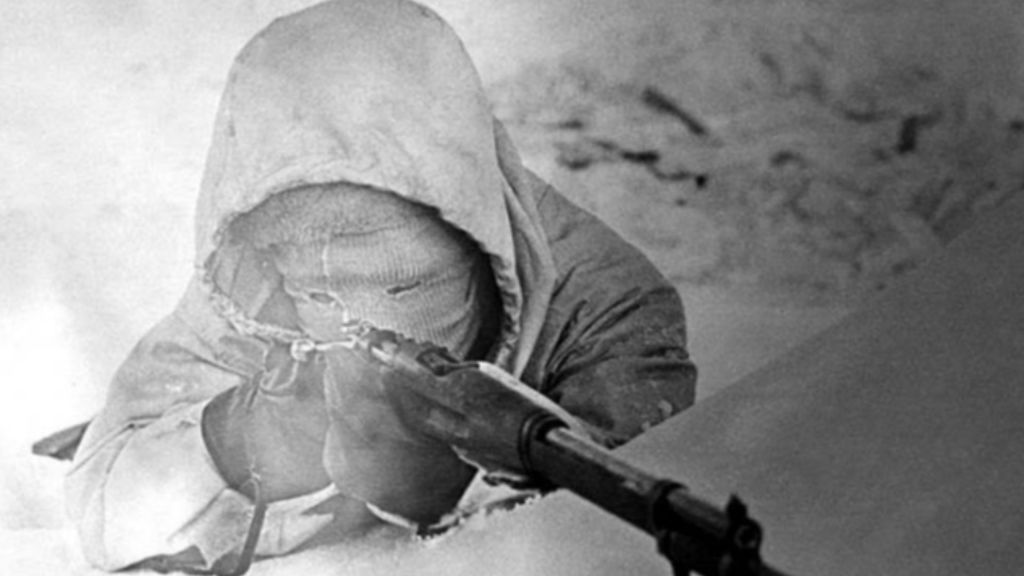
Day after day, week after week, Soviet soldiers entered the forests and never returned. Officers vanished without warning and crews collapsed before they even realised what was happening. As to be expected, panic soon erupted in the ranks. The Finns knew the perpetrator to be Häyhä, but the Soviets gave him the far more chilling name of ‘The White Death’.
As Häyhä’s reputation grew, so did the desperation of the Soviets. Counter snipers were sent out specifically to locate him, and artillery devastated entire regions of the forest that the Soviets believed he was hiding in. None of it worked. Häyhä simply moved away, waited, and struck again. An unseeable killer slowly picking off his enemies one by one.
When the Winter War finally ended, Häyhä had been officially credited with over 500 confirmed kills in just over 100 days of conflict. This made him one of the most successful snipers in history. Historians have looked back and suggested that he likely killed around 200 more soldiers in close combat engagements. Regardless of the specific number, it was clear that no other soldier had proved deadlier.
In war, however, it seemed impossible that anyone could survive such relentless combat forever. Only days before the war ended, Häyhä was struck by an explosive bullet to the face. The shot shattered his jaw and destroyed much of his lower face. Many believed him to be dead. However, against all odds, he survived, waking up on March 13th, the very day that Finland and the Soviet Union signed a peace treaty.
After the war had ended, Häyhä faced a long and painful recovery. The wound had required years of surgery before he could attempt anything resembling an ordinary life. Instead of seeking fame for his astounding achievements, he returned to the countryside, spending the rest of his life hunting, farming and breeding dogs. He rarely spoke of the war despite his prominent role, and preferred a life far from the spotlight. When asked how he had managed to do what he had done, he replied with a single word. ‘Patience.’


Leave a Reply