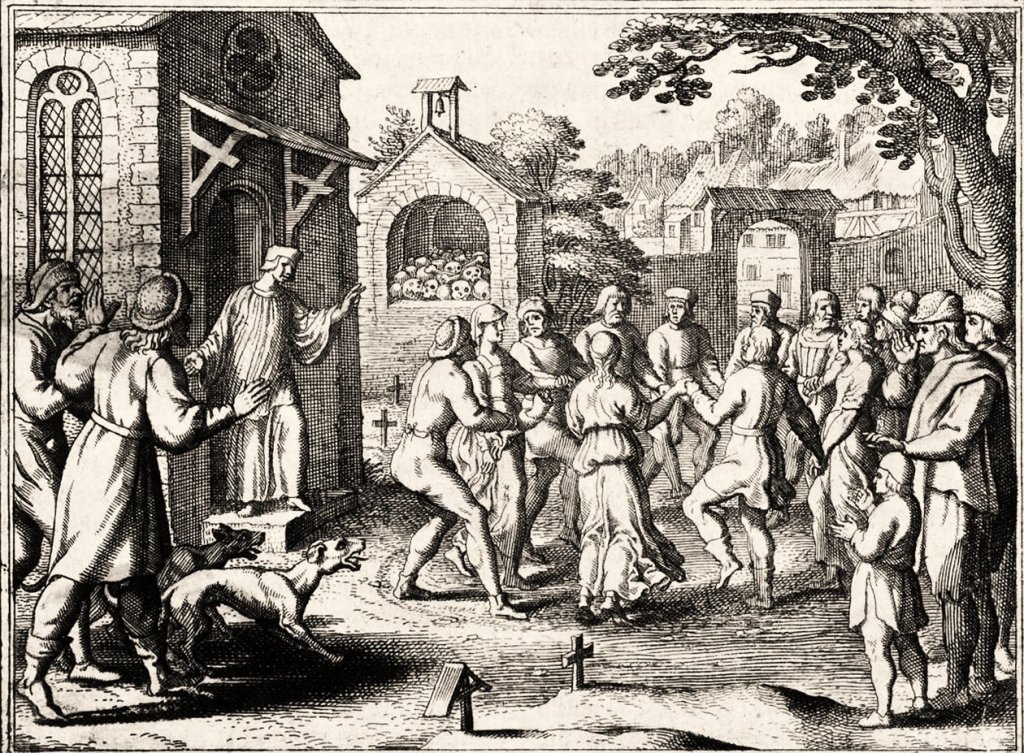
In July 1518, something strange began to occur on the streets of Strasbourg. It began with a single woman named Frau Troffea. One day, she walked onto the street and began to dance.
There was no festival taking place, and no celebration to cause such behavior. She simply started moving and kept going. For hours and hours, she hadn’t stopped. Her dancing went on to the next day, and then the day after that. To the people watching, it was an unsettling sight. At first, many may have assumed she was drunk or suffering from some sort of illness, but none of them could have imagined that this would go on to become one of the most bizarre episodes in European history.
The city of Strasbourg was busy in the early sixteenth century, standing along the Rhine and serving as a significant centre of trade. It was surrounded by numerous villages, farms and other communities, but life was not easy. Most of the ordinary people relied heavily on the yield of grain, and when harvest failed, or food became expensive, families rapidly found themselves in dire situations. The simmer of 1518 came after a period of hardship, in which widespread disease and hunger were already causing anxiety amongst the population.
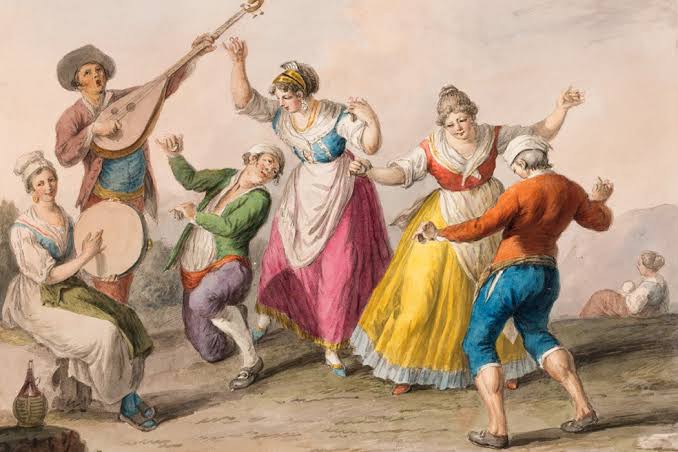
After several days of dancing, Frau Troffea found herself being joined by several other people. Gradually, their numbers grew. A handful soon became dozens, and the authorities eventually found themselves confronted with an unexplainable crowd of people who could seemingly not stop themselves from dancing. Men and women moved through the city, swaying and moving with no apparent reason. Spectators gathered soon, and the phenomenon continued to spread.
The heads of the city now found themselves with a serious problem.
They did not know what exactly was causing the dancing, but it was believed that it was a medical condition that would need treatment.
Medieval and Renaissance medicine still relied heavily on ideas inherited from ancient physicians, particularly the theory stating that health depends on the balance of fluids within one’s body. Doctors of the time believed that an imbalance of these fluids could cause illness, and that this case of unexplainable dancing was the result of excessive blood inside the brain.
Rather than physically trying to stop the dancers from moving, the authorities decided to simply encourage them to dance more! They reasoned that if dancing was caused by too much blood, then the physical exertion would surely remove the problem. Spaces were made specifically for the dancers, and according to reports, musicians were also brought in. Some accounts even mention a stage being constructed.
As the weeks passed, the scenario became even more disturbing. The dancers continued their movements with no proper rest. Dancing under normal circumstances is in itself tiring, but doing it repeatedly while distressed, poorly nourished and surrounded by a multitude of people made it even more so. People soon began collapsing from exhaustion, with several dozen being said to have died. Historians do not know the exact accuracy of this claim, since the surviving evidence doesn’t allow us to confidently establish the casualties.
Eventually, the people in charge realised that their approach clearly wasn’t working. They soon began trying to isolate the problem. Musicians were removed and constructed spaces were closed. Some who were affected were moved to a shrine dedicated to Saint Vitus, a figure traditionally associated with dancing disorders. People prayed for the afflicted to recover, with religious ceremonies performed.
Thankfully, the strange outbreak gradually ceased.
But what actually happened?
That question has remained a historical debate for historians ever since.
One of the most commonly used explanations is what modern researchers call mass psychogenic illness. This is a situation in which a large group of people develop real physical or behavioural symptoms that spread socially during times of extreme fear or stress. To the people experiencing it, everything can feel extremely convincing.
There is also the rather fascinating possibility that dancing was connected to expectations that already existed within European culture. There were traditions of the time that involved religious dancing, pilgrimages, and groupings of people seeking relief from illness. Stories about Saint Vitus described people suffering from involuntary movement. Hence, for somebody living in the year of 1518, the idea that a person could be struck by a mysterious dancing malady was not necessarily as ridiculous as it could be to us.
Another theory points in the direction of poisoned grain. A fungus called ergot can grow on rye and other grains, and if consumed, symptoms such as hallucinations, muscle spasms and convulsions can be caused. The European diet placed a heavy emphasis on grain, so ergot poisoning was a genuine danger. Therefore, it is suspected to be the cause of the Strasbourg outbreak. However, there are, of course, arguments against this as well. For example, Ergot poisoning is not known to result in the prolonged, socially spreading behaviour that happened.
There is, though, an even simpler possibility. Perhaps the historical stories have been greatly exaggerated. Over the centuries, details have been embellished, repeated and altered from their original contexts. It is simply too difficult to actually verify the number of people affected in this event, as there aren’t enough surviving documents on it.



Leave a comment