A step away from war.
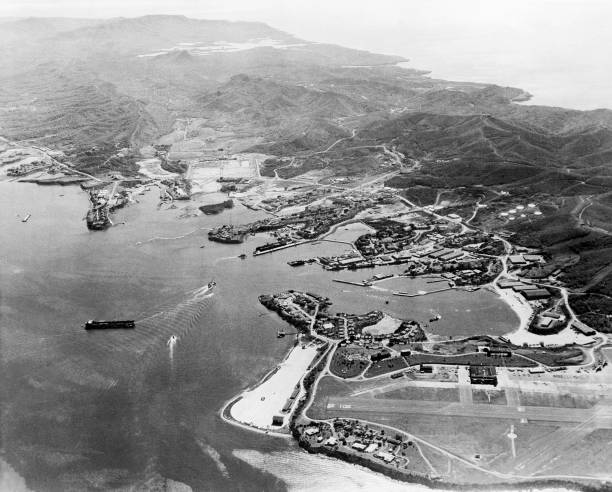
There are several points in human history when our nuclear capabilities have threatened us with war on an unimaginable scale. Perhaps the most famous of these is the Cuban Missile Crisis. For thirteen days, the United States and the Soviet Union were locked in a confrontation that threatened to escalate into full nuclear war. This was not merely a standoff over missiles in the Caribbean; it was the culmination of years of ideological rivalry, mutual suspicion, and general asserting of dominance during the Cold War. The resolution of this event reshaped global diplomacy, leaving an enduring strategy for nuclear power.
To understand the Cuban Missile Crisis, one must first understand the early Cold War. Following the Second World War, the US and the Soviet Union emerged as the global superpowers, each championing opposing political and economic systems: capitalist democracy opposed to communist authoritarianism. Though they never truly fought each other directly, both sides engaged fiercely in proxy wars, espionage, and general acts of competition across the globe.
By the late 1950’s, the force sitting at the centre of this rivalry was nuclear weapons. Both sides possessed thousands of these warheads, holding the power to devastate entire cities in minutes. Not the kind of thing you want your enemies to have. Thankfully, the policy generally agreed upon was deterrence, particularly the doctrine of mutually assured destruction. To put it simply, any nuclear war would in the end result in the complete annihilation of both sides involved. Fun. The solution seems pretty simple, right? No nukes. Unfortunately, this wasn’t quite so easy in practice, as any shift in a delicate strategic equilibrium could bring about drastic action.
Let’s shift the focus over to Cuba. The tensions of the Cold War were rather heavy with regard to Cuba after the Cuban Revolution of 1959, which brought Fidel Castro to power. Castro had overthrown the previous dictator, Fulgencio Batista, who had been supported by the US. Initially, Castro’s alignment was fairly neutral, but worsening relations with the US rapidly shifted Cuba into Moscow’s orbit.
Naturally, the US didn’t have the most favourable opinions about this. They viewed Castro’s socialist policies and increasing ties with the USSR as being unacceptable – especially given that Cuba lay only 90 miles from Florida. As a result, the US imposed a trade embargo and an authorised covert effort to destabilise Castro’s government.
This effort eventually led to the Bay of Pigs invasion in April of 1961, in which a CIA-backed force of Cuban exiles made an attempt to overthrow Castro. The coup was a failure, leaving a humiliating mark on President John F.Kennedy’s career and strengthening Cuban relations with the USSR. Now, for the Soviet Union, Cuba was both an opportunity and a vulnerability.
By 1962, the US held a significant advantage in nuclear delivery systems. This was especially prominent in their long-range intercontinental ballistic missiles (ICBMs). They had stationed some of these ICBMs, called Jupiter missiles, in both Turkey and Italy, placing Soviet territory within easy distance for strikes. Soviet leader Nikita Khrushchev aimed to address this imbalance. The most effective method he had was the deployment of his own missiles in Cuba. It would protect the Cuban regime, deter US aggression, and drastically alter the nuclear balance by placing key American cities within minutes of Soviet attacks. This was known as Operation Anadyr.
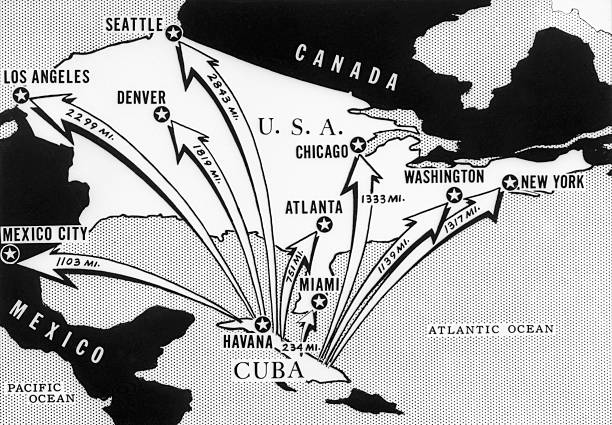
This operation was conducted under intense secrecy. By the summer of 1962, Soviet ships were transporting missiles and troops to Cuba, with the US remaining unaware for weeks.
On October 14th, a US reconnaissance aircraft photographed missile sites under construction in Cuba, leaving no doubt that the Soviet Union was constructing nuclear missiles capable of striking much of the US mainland. Two days later, this news reached Kennedy. For the next thirteen days, the world saw a time of crisis management unlike any other.
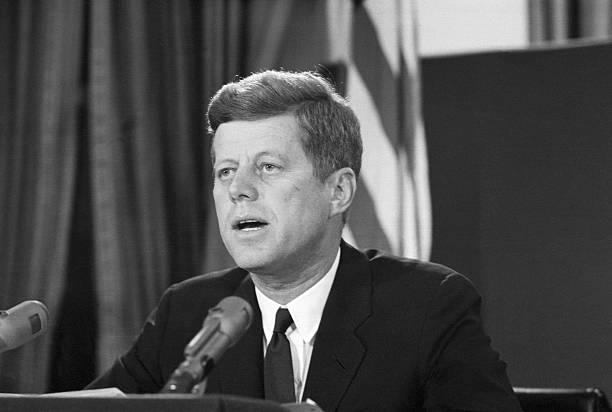
There were several options for the US on how to proceed, ranging from a diplomatic process to a full-scale invasion, with each option presenting its own set of risks. A response too mild would see the fortification of Soviet power, whilst a more decisive act would spark retaliation and consequent destruction. Ultimately, Kennedy chose a middle course, a naval quarantine of Cuba. The word ‘quarantine’ was chosen deliberately to avoid the legal implications of it being a ‘blockade’, which under international law would make it an act of war. Kennedy publicly demanded the immediate removal of all missiles from Cuba and placed all American nuclear forces on heightened alert. The world then watched as Soviet ships approached the quarantine line. One single misjudgement, a shot fired, a ship boarded, could have begun an uncontrollable escalation.
At the last moment, Soviet ships slowed or turned back, but this crisis was far from being over.
Following this, negotiations began behind the scenes, with tensions rising at a dramatic rate. On October 17th, often referred to as ‘Black Saturday’, the situation reached its most perilous point. A US plane had been shot down over Cuba by a Soviet surface-to-air missile. Many US military leaders demanded immediate retaliation. However, unknown to Washington, Soviet commanders in Cuba had already been given the authority to use tactical nuclear weapons in the case of an invasion. Had the US launched an assault, nuclear war may have begun in the Caribbean.
Throughout the entire event, Krushchev sent a series of letters to Kennedy. In exchange for the removal of missiles from Cuba, he demanded the dismantling of US Jupiter missiles in Turkey. With both sides wishing for peace, these terms were eventually accepted, and with the US removal of Jupiter missiles, the Soviet Union withdrew from Cuba on the 28th October 1962.
The Cuban Missile Crisis profoundly affected the dynamics of the Cold War. Both superpowers emerged shaken at the reality of how close they had both come to mutual annihilation. One of the most significant results of this was the Washington-Moscow hotline, a direct line of communication designed to prevent catastrophe due to miscommunication. Additionally, the Partial Test Ban Treaty of 1963 was signed, limiting nuclear weapon testing in the atmosphere, underwater and in space.
On the political side, Kennedy’s handling of the crisis enhanced his reputation as a strong yet cautious leader. Krushchev however, faced backlash and criticism, which contributed to his eventual removal from power in 1964.
Overall, the event remains a chilling example of how close we once were to facing nuclear conflict. It was shaped by human decisions, some reckless, some restrained, made under immense pressure, with the fate of millions resting on diplomacy and negotiation. Even to this day, geopolitical tensions persist, and the Cuban Missile Crisis stands as a sobering reminder that the margin between peace and catastrophe can be rather thin.
 Chronicles of History
Leave a comment