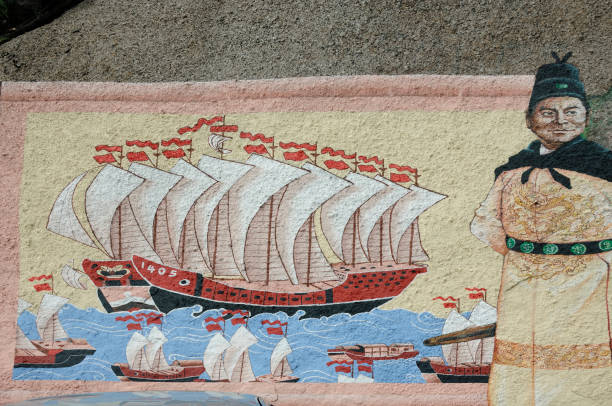
Fleet Admiral of the Ming
Usually, when we think of famous explorers, we’re met with a list of European sailors. But surely there were others? Allow me to introduce Zheng He – a name not as recognisable as Christopher Columbus, but whose accomplishments would make him the star of any 15th-century seafaring reality show.
Zheng He was born in 1371 in China’s Yunnan province under the name Ma He. The teenage Ma He was captured during a military campaign by Ming Dynasty forces, and it wasn’t exactly a vacation from there onwards. He was castrated (ouch), taken to the imperial palace in Nanjing, and became an eunuch under the Ming emperor Yongle. It’s safe to say it was a rough start to life.
But life has a funny way of working out. Zheng He quickly rose through the royal court, with his loyalty and intelligence gaining him a favourable reputation. Soon enough, the emperor took a liking to him and bestowed upon him the rather prestigious title of Admiral.
Now, let’s talk ships, and I don’t just mean a single one. Zheng He governed a vast fleet of around 300 boats, commandeered by 28,000 men. These were amongst the most impressive the world had ever seen, with some being more than 400 feet long, about four basketball courts.
The first of the voyages kicked off in 1405, and Zheng He went all out – the Strait of Malacca, around the Indian Ocean, and to the coast of East Africa. Along the way, he established trade routes, collected diplomatic gifts, and ensured everyone knew China was at the top of the hierarchy. By the time he’d returned in 1407, he had pretty much solidified his status as the ultimate globetrotter.
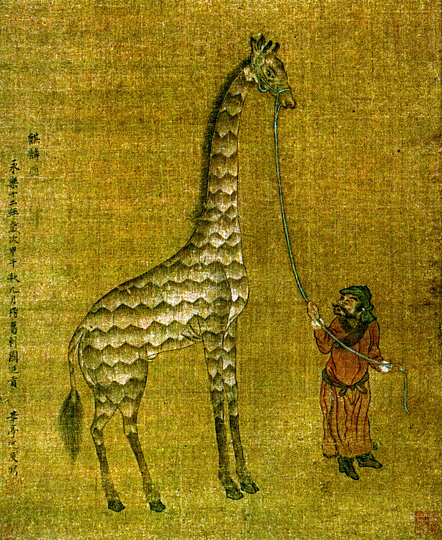
Over the next three decades, Zheng He and his fleet had undergone trips far and wide. His second voyage took him to India and Southeast Asia, and by his third trip, he was stretching the limits of known geography by travelling as far as the Horn of Africa. I’m talking about areas like Kenya, Somalia, and the Swahili Coast. The fourth, fifth, and sixth voyages involved navigating the Red Sea and landing in places like Egypt and Mecca. By this point, amongst the royal court, Zheng He had amassed brilliant achievements, with each voyage bringing back new and astounding items and animals. After one particular voyage, Zheng He, through cultural exchange in Arabia and Africa, brought back multiple animals never seen before by ancient China. The long-necked giraffe especially, was found particularly exciting.
In general, many would agree that Zheng He’s seventh and final voyage was the most memorable of all. The great eunuch was already in poor health at the age of 59, but still eager for the adventure. Besides, there were still several foreign envoys to be returned to their respective countries. In this last expedition, Zheng He once more reinforced the relationship between the Ming Dynasty and its surrounding nations, and on the return trip, he died and was buried at sea.
The grand seafarer’s death represented the end of an era for China. The powerful Confucian faction of the court withdrew China’s interest in foreign affairs and focused more on internal affairs, closing itself off to most of the outside world. The precious treasure fleet was dismantled, and records of Zheng He’s travel were erased by scholars uninterested in ‘wasteful’ exploration. This resulted in the Europeans, who landed only a few decades later, establishing themselves as the superior power. Irony at its finest.
In the end, despite many actions after his death that diminished the fame of his voyages, Zheng He remains an astounding figure in the annals of history. It wasn’t until centuries later that historians finally realised just how influential these expeditions truly had been. He hadn’t just travelled for glory; he sailed to build relationships, exchange goods, and spread a message of peace and cooperation to the world.
 Chronicles of History
Leave a comment